
“Developing the Ability to Carefully Select Learning Materials for Self‑Study”
“High‑Quality One‑Session Intensive Workshops”*
*These workshops consist of the following three components, designed to enhance the quality of self‑directed learning and to be applicable to learning in other fields:
–Learning essential principles, representative techniques, and glimpses of advanced skills
–Co‑creating a single work
–Appreciating a professional performance
In today’s world—where technological innovation enables people to access a vast amount of high‑quality content from early childhood and requires them to continue acquiring diverse skills throughout their lives.
These elements are increasingly essential across all educational settings.

To be able to design meaningful learning environments for lifelong education,
I have intentionally cultivated a wide range of skills myself and have consistently kept these principles in mind
when learning how to create teaching materials and workshops.
Here “Japanese Cultures & Lifelong Education”
Languages: Study Materials & Workshops
Table of Contents
-International Sign Language
-International Gesture Etiquette
-Japanese Sign Language
-Communication Sheets: Point‑and‑Speak Illustrations and Words
-Braille
-Learning Support Materials for Children of Foreign Nationality in Japan
-Easy Japanese:やさしい日本語
-Português
-Español
-Japanese Language Education: Methods for Teaching Japanese to Non‑Native Learners
-English: Support for Tourism and School Activities in Japan
*中文(Chinese) is studied using second‑language materials from university courses.
*Several additional books consulted on developing expressive abilities for adults, young learners, and exam‑preparation students are omitted here.
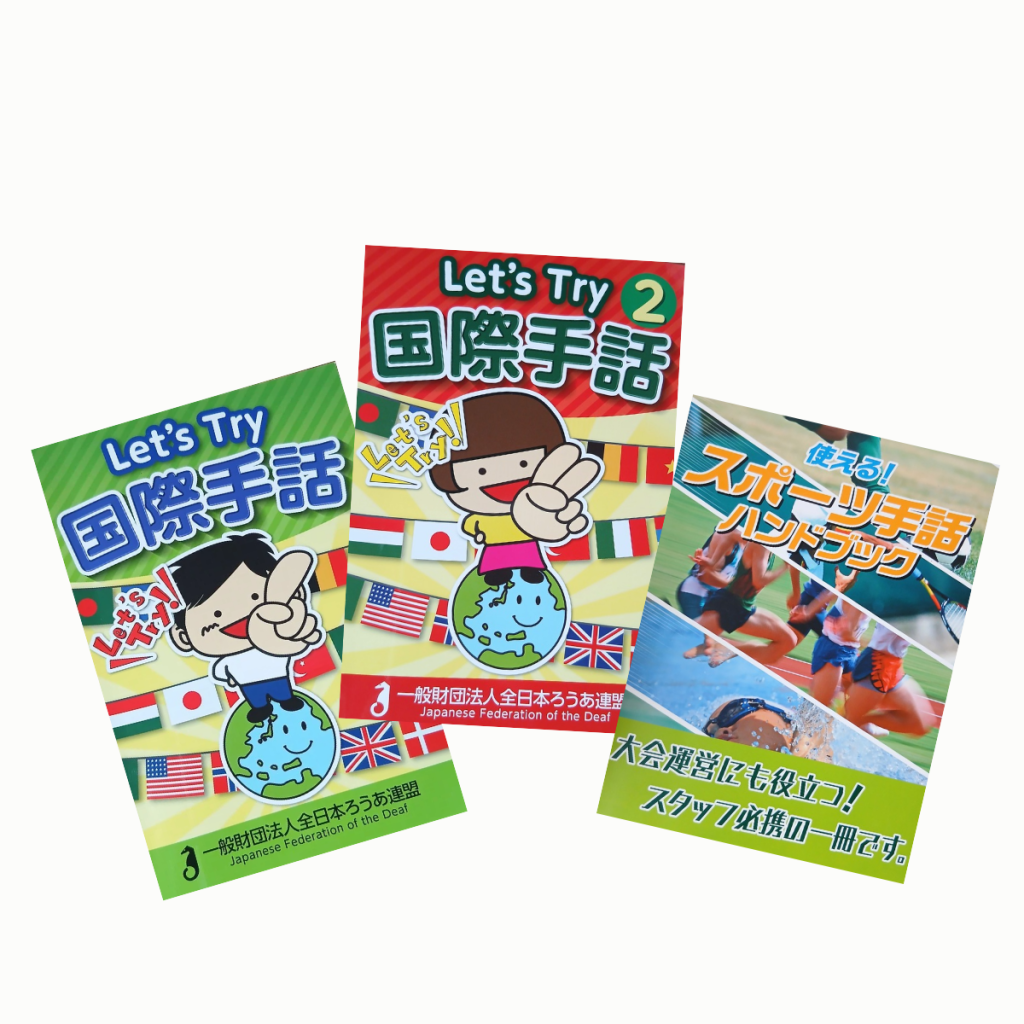
International Sign Language
By the “Japanese Federation of the Deaf“
Let’s Try International Sign Language (2019, ISBN 978-4-904639-22-1 C0037)
Let’s Try International Sign Language 2 (2020, ISBN 978-4-904639-24-5 C0037)
Useful! Sports Sign Language Handbook (2018, ISBN 978-4-904639-19-1 C0580)
*Federation was established in 1947. It is the only nationwide organization of parties concerned of the Deaf in Japan, which has under its umbrella organizations in each prefecture across Japan.
Its purpose is to respect the human rights of the Deaf, improve their cultural standards, and promote their welfare.
International Gesture Etiquette
-“Multilingual Point‑and‑Speak Communication Sheets” created by Kumamoto Prefecture*
Food & Beverage / Accommodation / Transportation / Retail / Financial Services
*A southern region of Japan with a high number of international tourists.
– Created around 2020 by Japan Tourism Agency del Ministry of Land, Infrastructure, Transport and Tourism with National Government Licensed Guide Interpreter*.
*Japan’s national qualification for professional guides who provide interpretation and tourism services to foreign visitors.
Japanese Sign Language
–Koto City, Tokyo (2020) – Public Information Pamphlet
‐Gunma Prefecture: Public Awareness Leaflet
*Websites of other local governments as well
Communication Sheets: Point‑and‑Speak Illustrations and Words
‐Meiji Yasuda Mental Health Foundation (Public Interest Incorporated Foundation)
-By Kumamoto Prefecture*
中文, English, Korean
‐By Japan Tourism Agency del Ministry of Land, Infrastructure, Transport and Tourism with National Government Licensed Guide Interpreter*
*Same as “International Gesture Etiquette” above.

Braille
Organizer: Takasaki City
“FY2025 Career Design Support Program – Experiential Workshop on Supporting Persons with Visual Impairments”*
Instructor:Seiichi Hatamura, President of the Takasaki Braille Volunteer Association*
*46 years since its founding
Date: January 2026
Venue: Takasaki City Central Community Center
*The city’s program consists of two sessions.
Session 1:
“Listening to the real‑life experiences of persons with visual impairments and considering what kinds of support are needed”
“Learning appropriate verbal assistance and guiding techniques through simulated experiences”
Instructor: Toshiko Izumi*
*She herself has a visual impairment. Together with her grandchild, she participates in marathons and 100‑kilometer walking events.
She also plays the ocarina. She serves as a board member and head of the Women’s Division of the Gunma Prefecture Association for the Welfare of the Visually Impaired.
Learning Support Materials for Children of Foreign Nationality in Japan
-Jointly developed teaching materials by a major trading company and a leading university in foreign language and international liberal arts education.
“Teaching Materials for Multicultural and Multilingual Children”
Mathematics and kanji materials for Grades 1 to 3 of elementary school
*Some mathematics units also cover content from higher grades.
Teaching materials for children from Spanish‑speaking regions of South America: “PROYECTO CÓNDOR”
Teaching materials for Brazilian children living in Japan: “PROJETO TUCANO” are also referenced.
*Mitsui & Co., Ltd. *Tokyo University of Foreign Studies, Center for Multilingual Multicultural Education and Research (CEMMER).It has produced many diplomats and employees of international trading companies.
-Prepared by the International Education Planning Division, Global Human Resource Development Department, Tokyo Metropolitan Board of Education
“Japanese Language Instruction Textbook for Foreign Children and Students Tanoshi Gakko(Fun School)”
Revised editions in Spanish, Portuguese, and English (March 2024)
Easy Japanese:やさしい日本語
Methods for conveying information in Japanese—both spoken and written—in ways that are easy for foreign residents to understand by avoiding heavy use of kanji, idiomatic expressions, Japanese made loanwords, and culturally specific indirect phrasing.
These methods also include techniques for creating Japanese expressions that can be easily processed or replaced by translation devices.
Such practices spread after the 1995 Great Hanshin–Awaji Earthquake. Initially, they were promoted as an emergency communication language for foreign residents during the first 72 hours after an earthquake.
After the 2011 Great East Japan Earthquake, they further developed into methods for producing longer texts that could be adapted or replaced after the 72 hour period.
Since around 2020, these approaches have expanded in fields such as tourism services for foreign visitors, welfare services for persons with disabilities, and learning support for young children.
—Prof. Kazuyuki Sato, Guidelines for Creating “Easy Japanese”, Hirosaki University Sociolinguistics Laboratory, 2013 (Expanded Edition), revised in 2020.
These guidelines have been widely used as a representative grammatical reference when local governments created their own public information leaflets around 2020.
Research began after the Hanshin–Awaji Earthquake, and the first edition was published in January 2010, fifteen years after the disaster.
One year later, the Great East Japan Earthquake occurred, prompting improvements that enabled the creation of longer texts suitable for communication after the initial 72‑hour emergency period.
-Por National Institute of Information and Communications Technology(NICT)
“How to Use VoiceTra Effectively”*
*A manual created by the same organization for its multilingual speech‑translation application.
It explains that translation apps cannot be used effectively unless the user understands the principles of creating “Easy Japanese,” such as avoiding complex kanji, idiomatic expressions, and culturally specific indirect phrasing.
– Immigration Services Agency of Japan y Agency for Cultural Affairs,Government of Japan (2020)
Jointly Developed“Guidelines for Easy Japanese for Resident Support”
“Supplement: Examples of Easy Japanese Rewriting”
-NHK WORLD-JAPAN* Broadcast‑based Teaching Materials
“Easy Japanese-やさしい日本語”(Beginner Level, 48 Lessons in Total)
“しごとのにほんごEasy Japanese for Work”
* NHK (Japan Broadcasting Corporation)-Japan’s only public media organization. NHK WORLD‑JAPAN is the international broadcasting and service arm of NHK.
-Teaching materials created in March 2024 by Gunma Prefecture and Lin Com,
Gunma is home to a regional city* with a long history of coexistence with foreign residents and nationally recognized advanced initiatives.
*A local city known for pioneering efforts in multicultural coexistence in Japan.
*Ota-shi, Ora-machi, Isesaki-shi…
‐Materials created by industrial cities with a long history of coexistence with foreign residents and by tourist destinations highly popular among international visitors.
These documents are published on the official websites of the respective local governments.
Toyohashi-shi,Aichi Prefecture (2025)

Português
-Mikio Tomino “From Spanish to Portuguese”* (1989, Daigakusyorin)
*A practical and scholarly comparative grammar of Spanish and Portuguese.
The author is one of the editors of Dicionário do PORTUGUÊS Contemporâneo, Third Edition (2014, Hakusuisha), a Portuguese–Japanese dictionary recommended to students by The University of Tokyo—Japan’s top university—as well as by other institutions.
He graduated from the Tokyo University of Foreign Studies and is a professor in the Department of Spanish and Latin American Studies, Faculty of Foreign Studies, Nanzan University*.
*Nanzan University is a long‑established private university located in Nagoya, one of Japan’s major industrial cities.
—The aforementioned Portuguese–Japanese dictionary.
– Tanoshi Gakko by Tokyo Metropolitan Board of Education*
*Same as《Learning Support Materials for Children of Foreign Nationality in Japan》above.
Español
-Tokyo University of Foreign Studies: Free Multilingual Learning Materials
“TUFS Language Modules” (Open-access online resources)
– Yoshiro Yamada,“GRAN DICCIONARIO ESPAÑOL-JAPONÉS”(2015, HAKUSUISHA)
-Noboru Miyagi,“DICCIONARIO DEL ESPAÑOL MODERNO:EDICIÓN REVISADA”(1999, HAKUSUISHA)
-Toshihiro Takagaki,“SHOGAKUKAN DICCIONARIO ESPAÑOL-JAPONÉS SEGUNDA EDICION”(2007)
– Toshihiro Takagaki,“Progressive Vocabulary Book: Essential Spanish Words from Japanese” (2004, Shogakukan)
– Yoshimi Hiroyasu,“CD Book Step 30: One-Month Intensive Spanish Course” (2006, NHK Publishing)
-Masayo Tanimoto, “Somewhere Other Than Here! Point-and-Speak Travel Phrasebook 40: Argentina” (2016, Jōhō Center Publishing)
– Tanoshi Gakko by Tokyo Metropolitan Board of Education*
*Same as《Learning Support Materials for Children of Foreign Nationality in Japan》above.
Japanese Language Education: Methods for Teaching Japanese to Non‑Native Learners
– Tokyo University of Foreign Studies Website
“TUFS Language Modules” (Open-access online resources)*
*Same as《Español》above.
-By NHK WORLD‑JAPAN
*Same as《Easy Japanese:やさしい日本語》above.
– Human Academy*“Japanese Language Education Textbook: Complete Preparation Guide for the Japanese Language Teaching Competency Test, 5th Edition” (Shōeisha, 2021) — currently studying
*Training institution for the nationally certified qualification “Nationally Registered Japanese Language Teachers”.
English: Support for Tourism and School Activities in Japan
-By Kumamoto Prefecture*
Food & Beverage / Accommodation / Transportation / Retail / Financial Services
‐By Japan Tourism Agency del Ministry of Land, Infrastructure, Transport and Tourism with National Government Licensed Guide Interpreter*
*Same as “International Gesture Etiquette” above.
– Tanoshi Gakko by Tokyo Metropolitan Board of Education*
*Same as “Learning Support Materials for Children of Foreign Nationality in Japan” above.

© 2026 Rika Ogasawara